

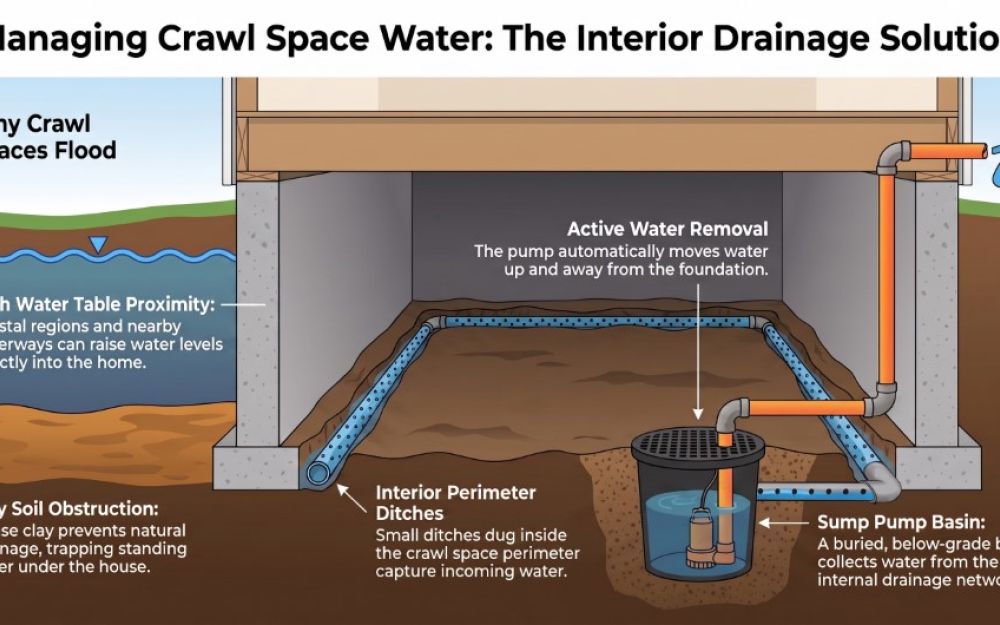
Why Is There Water in My Crawl Space? (Even When It Hasn’t Rained)
It hasn’t rained in a week. The sun’s been out, your grass is turning brown, and for once the Hampton Roads humidity is behaving itself. Then you pop the hatch to your crawl space and get hit with that heavy, damp, basement-y smell — and there it is. Standing water.
If that’s ever happened to you, you’re not losing your mind, and it’s probably not a busted pipe. Around here, “dry-weather flooding” is one of the most common calls we get. To most homeowners, it feels like a mystery. To anyone who’s spent years crawling around under Coastal Virginia houses, it’s about as predictable as the tide. Because that’s basically what’s happening — the tide, geology, and your foundation are all fighting over the same few feet of dirt, and your crawl space is caught in the middle.
There may be a hidden pond sitting a few inches under your living room floor right now, quietly working against your house while the sun shines.
Around Here, Geography Is Destiny
If you live in Hampton Roads, your home’s health is tied to the water around it, whether you think about it or not. Elizabeth River, the James, or any of the hundred little tributaries winding through the region — it doesn’t matter which. You’re on wet ground.
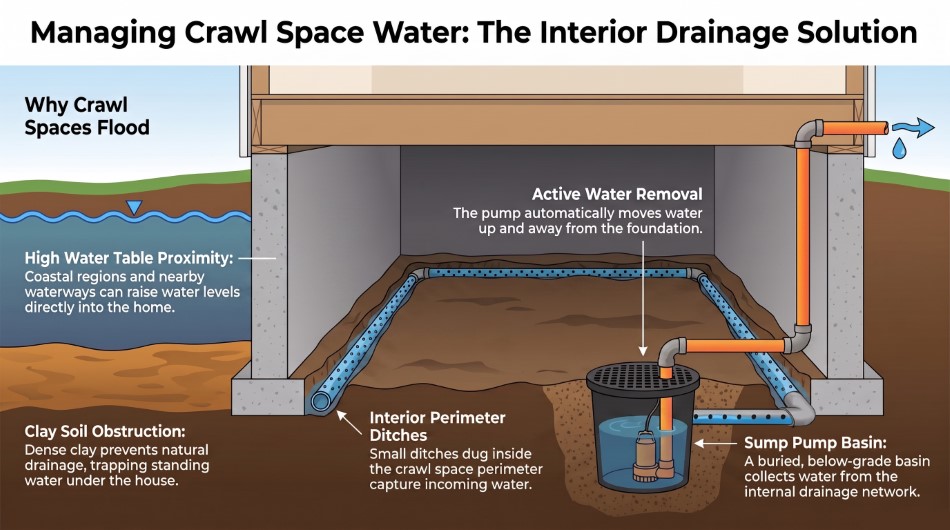
The usual suspect is a high water table. Rain comes and goes. The water table doesn’t. It sits there, constantly pushing against your foundation, and that steady pressure is what people underestimate.
We tend to picture our yards as flat, solid ground. They’re not. The earth beneath is layered and tiered, and your crawl space floor sits several feet below it. If that floor isn’t well above the local water level, congratulations—you now own the bottom of the bowl. Water doesn’t leak in through a crack. It seeps up and in from every direction, and the ground quietly reclaims the space as part of the local waterway. Forecast has nothing to do with it.
When the Dirt Itself Is the Problem
Say your water table is sitting at a safe depth. You’re still not off the hook, because Virginia soil has another trick.
A lot of our regional ground is heavy clay. Dense, stubborn stuff that basically refuses to drain. Sandy soil lets water filter straight down and disappear. Clay does the opposite—it holds water like a sealed bowl. So when a big storm finally rolls through, the water can’t sink. With nowhere to go down, it goes sideways instead, hunting for the path of least resistance.
That path is almost always the hollow void under your house.
I’ve seen genuine lakes under people’s homes for exactly this reason — the water had nowhere else to be. And once it settles into that low spot, the same clay floor that trapped it also refuses to let it soak back out. So it just sits. And standing water is what feeds mold and rots your joists.
The Vapor Barrier Trap
Here’s where it gets ironic. That thick plastic liner across your crawl space floor—the vapor barrier—is supposed to protect you. It shields the house from ground moisture, and normally it does its job well.
But get water on top of it and everything flips.
Instead of a shield, you’ve got a pool liner. The plastic pins that stand water right up against your subfloor and joists, keeping it from draining. Without somewhere for it to go, the exact thing meant to keep your house dry now guarantees that once it gets wet, it stays wet. Indefinitely.
Stop Mopping. Start Capturing.
You can’t fix a lake by bailing it out. Passive protection isn’t enough once water is getting in — you need to manage where it goes actively. The most dependable fix for our climate is a “capture and route” system that lets gravity do the heavy lifting.
A proper permanent solution has two parts working together:
Interior French drains. We dig sloped drainage channels around the inside perimeter of the crawl space. These aren’t just trenches — they’re gravity-fed lanes built to grab water the second it crosses the perimeter, before it can spread across the floor.
A below-grade sump system. Those channels feed the water toward a sump basin set at the lowest point of the space. Because the basin and pump sit below grade, they catch water before it ever pools on the surface.
The best part is that you don’t have to do anything. No switch to flip, no checking on it after every storm. When the basin fills, the pump kicks on by itself, pushes the water up and out, and dumps it well away from your foundation. It’s a mechanical backstop for soil that would never have drained on its own.
What’s Really at Stake
Ignore what’s happening under your house, and you’re gambling with the part of it that holds everything else up. Constant moisture down there leads to foundation trouble and lousy indoor air, and neither one fixes itself. Trading the reactive cleanup routine for an automated drainage system keeps your home a home rather than a holding tank for stagnant water.
So next time you’re standing in your living room, think about what’s underneath the floorboards. Solid, dry ground? Or a hidden lake, just waiting for the next tide to come up?