

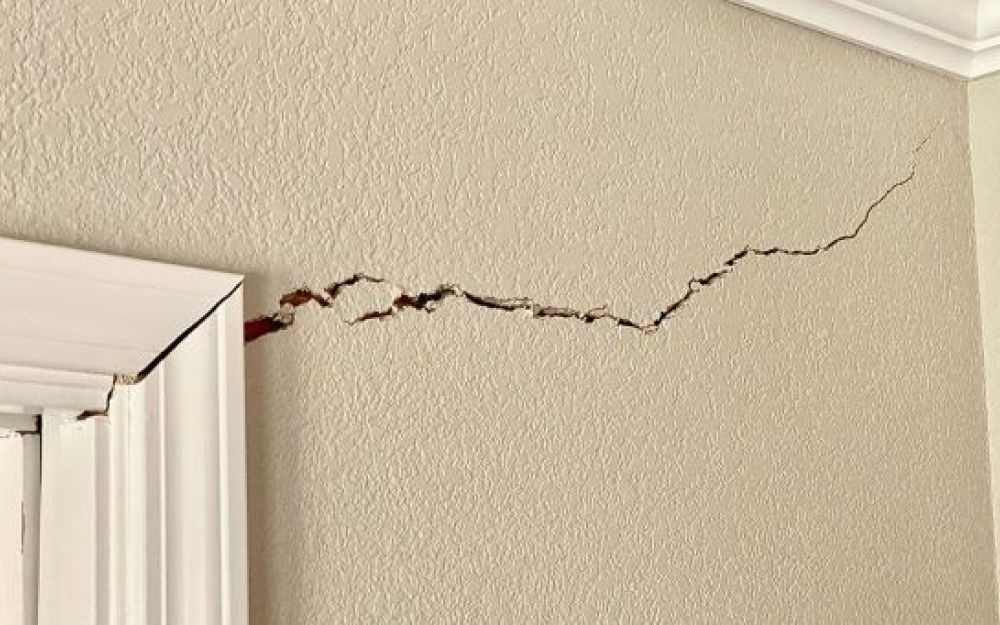
Most homeowners have seen them. A thin line running from the corner of a window frame. A hairline crack above a doorway. A gap along the ceiling where the drywall meets the wall. You patch it, paint over it, and forget about it — until it comes back six months later, a little wider this time.
That’s usually when people start wondering if something bigger is going on.
Here’s the truth: some cracks are completely harmless. Others are telling you something your foundation has been trying to say for a while. Knowing the difference matters.
The Cracks You Don’t Need to Worry About
Houses settle. It happens in new construction, it happens in older homes, and it’s completely normal. As a house moves through temperature and humidity cycles year after year, the framing expands, contracts, and shifts slightly. Drywall isn’t flexible — so it cracks.
Hairline cracks, especially horizontal ones running along taped seams, are almost always cosmetic. Same with small cracks in the corners of rooms or at the edges of ceilings. These show up because drywall compound shrinks slightly as it dries and can separate from the tape over time. Annoying to look at, but structurally meaningless.
If you can cover it with a credit card and it hasn’t changed in years, you’re probably fine.
The Cracks That Deserve a Closer Look
Not all cracks are created equal. There are a few patterns that consistently show up in homes with underlying structural or foundation problems — and they look different from the garden-variety settlement crack.
Diagonal cracks from the corners of doors and windows. If you’re seeing cracks that shoot diagonally from the corner of a door frame or window opening, that’s a stress pattern. It means that area of the wall is under uneven load — often because the foundation below it has moved or a structural support has shifted.
Cracks that are wide at one end and narrow at the other. A crack that tapers, with one end noticeably wider, points to differential movement. One side of a wall has shifted more than the other. That doesn’t happen from drywall drying out.
Stair-step cracks in corners. When you see cracks that follow a stair-step pattern in the corner where two walls meet, or where the wall meets the ceiling, that typically means the structure is racking — moving out of square. Foundation settlement or soil movement is frequently the cause.
Cracks that keep coming back. You fix it, and in a year it’s back, wider than before. That’s not a drywall problem. That’s the symptom of a moving problem — and painting over a moving problem doesn’t solve it.
Why the Crawl Space Matters
This is where a lot of homeowners get surprised. A cracked wall in your living room might have nothing to do with what’s happening above the foundation — and everything to do with what’s happening in the crawl space below it.
Excess moisture in a crawl space leads to wood rot in the floor joists and beams that support your home. When those structural members weaken, the floor above them starts to move. When the floor moves, the walls move. And when the walls move, the drywall cracks.
Poor drainage, unsealed crawl spaces, and failing vapor barriers are some of the most common culprits. None of them are visible from inside the living space. You’d never know just by looking at the crack.
That’s why, when a crack keeps coming back or shows up in multiple locations around the home, a crawl space inspection is often the right first step — not a drywall repair.
Get an Expert Set of Eyes On It
A crack that’s purely cosmetic costs almost nothing to fix. A foundation or structural problem that goes unaddressed for years can turn into a very expensive repair.
If you’re seeing cracks that fit any of the patterns above — diagonal, recurring, widening, or showing up in multiple spots around the house — it’s worth having someone take a look underneath the home before you pick up the spackling compound.
BAY Crawl Space & Foundation Repair serves the VA & NC – Coastal & Inland regions and provides thorough on-site inspections to get to the root of what’s actually causing the problem. Call (757) 460-0444 to set one up.